Soccer: Love for The Beautiful Game
Before the whistle, the stands do the talking. Four displays from Dortmund, Istanbul, Marseille and Milan show what football culture looks like when supporters become the artists.
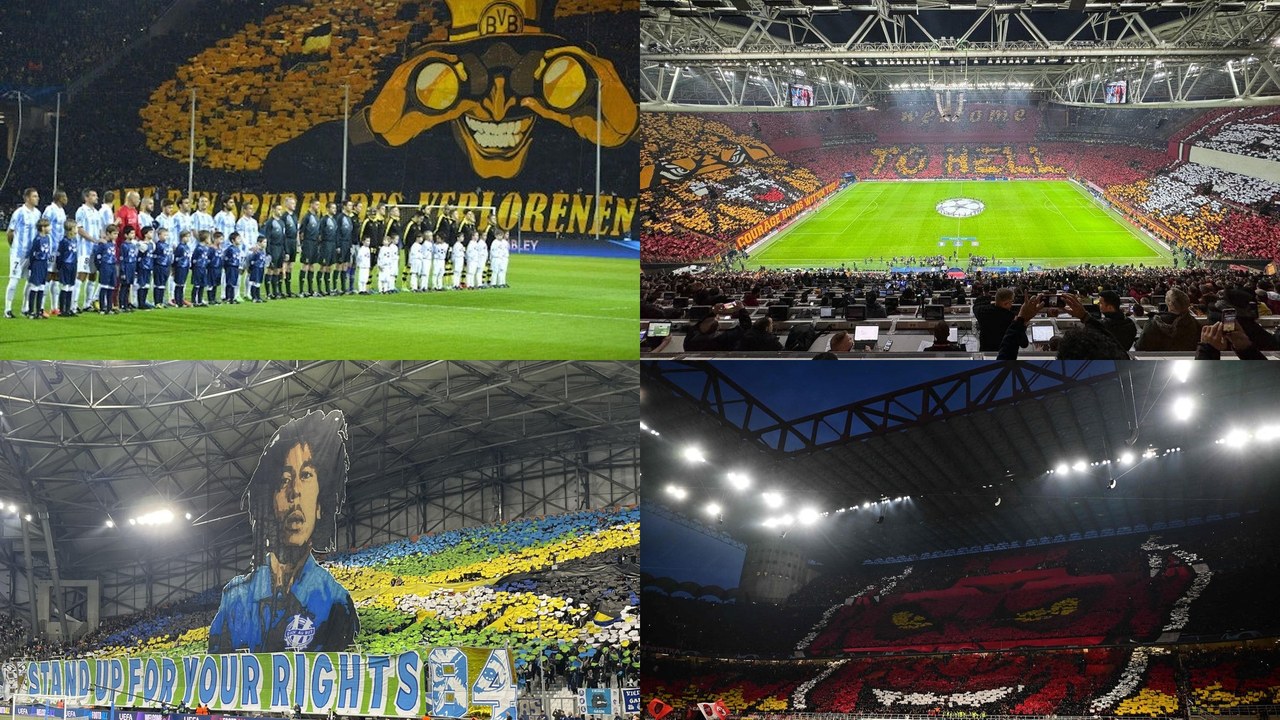
Football is played for 90 minutes, but for the people in the stands it starts weeks earlier. Groups of supporters design, fund and rehearse enormous displays, then unveil them in the minute before kick-off. The Italian word for it is tifo, from tifosi, the fans who are said to be feverish for their team. The four pictures on our cover come from four different countries, and each one says something about the club behind it.
What you need to know
- What a tifo is: a coordinated stand display made from flags, banners, coloured cards and giant canvases, planned and paid for by the supporters themselves.
- Dortmund, 2013: the Yellow Wall hunted for the "lost" Champions League trophy against Málaga, then won 3-2 with two goals in stoppage time.
- Galatasaray, 2023: a red-and-yellow mosaic with a lion and the words Welcome to Hell before a 3-3 draw with Manchester United.
- Marseille and Milan: a Bob Marley portrait in the Vélodrome's Virage Sud and the red devil of the San Siro Curva Sud, two very different ways to say the same thing.
Where the word comes from
Tifo comes from the Italian for typhus fever, and tifosi are the supporters who seem to have caught it. The culture of organised, choreographed support grew up in Italian stadiums, where the curves behind the goals became the home of the ultras, and it has since spread across Europe and the rest of the world.
What separates a tifo from ordinary singing and flag-waving is planning. A large display needs a design, a budget, volunteers to cut and paint, and often thousands of people who all hold up the right card at the right second. Many are kept secret until the moment they are revealed.
Dortmund 2013: the man with the binoculars
On 9 April 2013, Borussia Dortmund hosted Málaga in the second leg of a Champions League quarter-final, with the first leg having finished 0-0. Behind one goal, the Yellow Wall, the huge standing terrace of the Südtribüne that holds around 25,000 people, unveiled a giant figure with a pair of binoculars and the words Auf den Spuren des verlorenen Henkelpotts, roughly "on the trail of the lost Henkelpott". Henkelpott, the "pot with handles", is the German nickname for the European Cup. Dortmund had not won it since 1997.
The match followed the script of a fairy tale. Málaga led 2-1 with the clock running down, and then Marco Reus scored in the 90th minute and Felipe Santana made it 3-2 in the third minute of stoppage time. Dortmund went on to the final at Wembley, where they lost 2-1 to Bayern Munich, but that night against Málaga is still the one fans bring up first.
Galatasaray 2023: welcome to hell
Istanbul has a reputation to protect. On 8 November 2023, Galatasaray welcomed Manchester United to Rams Park for a Champions League group match, and the home stands turned red and yellow. A lion filled one end, and the words Welcome to Hell were spelled out across the main stand behind the goal. The phrase is a piece of club history: it goes back to the 1993 European Cup tie between the same two clubs, when United's players were greeted with that message in Istanbul.
The mosaic was matched by the noise, and the match itself delivered. It finished 3-3, a result that kept Galatasaray alive in the group and added another chapter to a reputation the club has spent three decades building.
Marseille: Bob Marley in the Vélodrome
Marseille's supporters are known for pyrotechnics and flags, but the display on our cover is one of the most artistic in French football. A huge portrait of Bob Marley, wearing an OM jacket, rises over a mosaic of blue, white, yellow and green, and a banner underneath reads Stand Up for Your Rights, a nod to the reggae singer's best-known protest song. The number 84 on the banner refers to Commando Ultra '84, one of the groups that organise the Virage Sud, the south curve of the Vélodrome.
It is a reminder that a tifo does not have to be about the match. The Vélodrome, with a capacity of about 67,000, is one of the loudest stadiums in Europe, and its supporters use it to talk about music, the city and the idea of standing up for your own.
Milan: the red devil of the Curva Sud
At the San Siro, the Curva Sud has produced some of the most elaborate choreographies in Italy, and the devil is its most famous symbol. It is not decoration. Milan's founder Herbert Kilpin supposedly said in 1899 that the club would be a team of devils, with colours "as red as fire and as black as the fear we will cause our opponents". More than a century later, a giant devil's face covering the curve, flanked by red and black card sections, still tells opponents where they are.
A display like this takes weeks. Thousands of cards have to be distributed and numbered, the section leaders have to rehearse the cues, and the whole thing has to work under the roof's shadow and floodlights for a single minute.
Why it matters
Tifos are not a side show. They are free of charge to the club, they are made by the people who show up every week, and they give a stadium an identity that a television audience can see before a ball is kicked. Dortmund's binoculars, Galatasaray's lion, Marseille's Marley and Milan's devil are all, in different ways, love letters to the game.
That is the real point of the title. Football's beauty is not only in the goals, but in what the people watching bring to the ground, and the best of them are remembered as long as the matches themselves.
Sources: BVB.de (Borussia Dortmund) and Bundesliga.com on the 2013 Yellow Wall display; Ligue 1 and NSS Sports on Marseille's Virage Sud displays; match reports from the BBC, Reuters and UEFA.com on Galatasaray v Manchester United (8 November 2023); club histories of AC Milan. Choreography details are descriptions of the photographs on our cover.
Related Content
Can Mbappé or Haaland Catch Ronaldo's Champions League Goal Record?
Arda Güler, The Magician